Why the Smart Money Confidence Matters
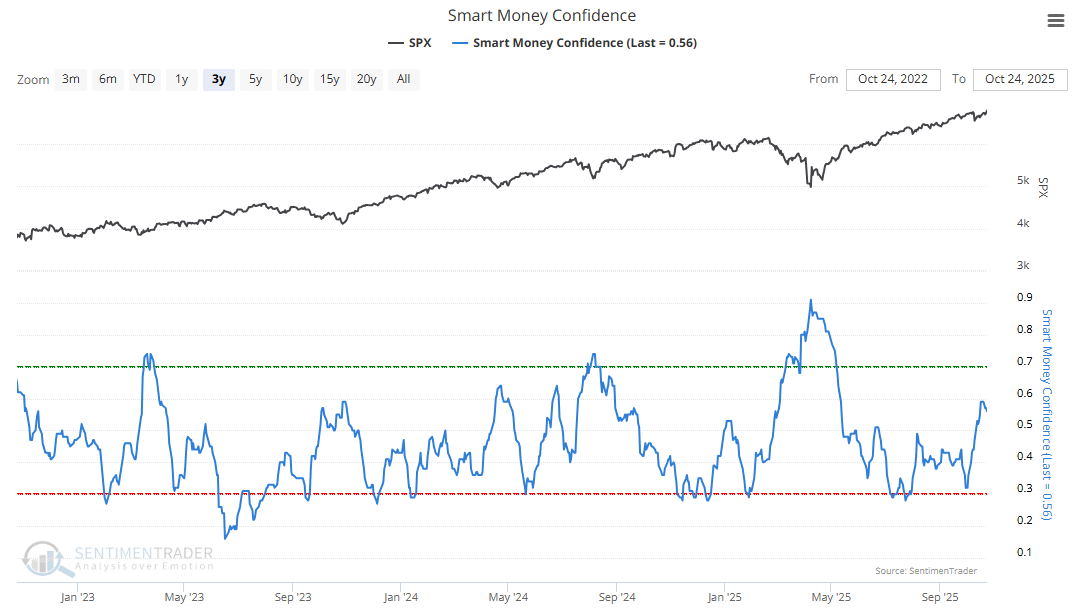
While retail sentiment often follows price, institutional sentiment tends to lead it. The Smart Money Confidence indicator captures these early shifts — when experienced investors buy weakness or trim exposure near market peaks.
Clarity: Quantifies institutional sentiment that often runs counter to public emotion.
Context: Reveals how professional hedgers and contrarian traders behave at key inflection points.
Insight: Highlights potential turning zones when “smart money” confidence diverges sharply from crowd optimism.
How Traders Use the Smart Money Confidence
High Confidence (Above 70%) – Historically associated with strong forward returns. Indicates institutional accumulation during pessimism and often precedes 1–3 month rallies.
Low Confidence (Below 30%) – Suggests professional investors are cautious or hedged, typically appearing near overbought or euphoric markets.
Neutral Range (30–70%) – Reflects balanced positioning where the “smart money” is neither aggressively contrarian nor defensive.
Behavioral Tendency: Smart Money Confidence usually rises as markets fall and declines as they rise — a mirror image of crowd-driven sentiment.
Smart Money / Dumb Money Confidence Spread: Traders often pair Smart Money Confidence with its counterpart, Dumb Money Confidence. The difference between the two, known as the Smart Money / Dumb Money Confidence Spread, offers a clearer view of how institutional sentiment diverges from retail emotion. A widening spread often signals an approaching turning point as professional investors position against the crowd.
The Technical Bit
Calculation and components
Smart Money Confidence aggregates sentiment measures from sources historically associated with institutional hedging and contrarian positioning.
Key components include:
OEX Put/Call and Open Interest Ratios – Tracks institutional options hedging activity.
Commercial Hedger Positions in Equity Index Futures – Reflects how professional traders adjust exposure in futures markets.
Stock–Bond Relationship – Evaluates the flow between risk assets and safe havens to gauge professional risk appetite.
Each input is standardized and blended into a 0–100% confidence scale:
Values rarely reach these extremes but typically oscillate between 30–70%, with reversals often developing when the index pushes beyond either boundary.
What This Means for Traders
Smart Money Confidence gives traders a behavioral lens into how the most disciplined market participants position at emotional extremes.When these professionals become notably confident amid public pessimism, markets often rebound — not because of emotion, but because positioning shifts are already in motion.
Since sentiment can remain extreme for extended periods, traders often combine Smart Money Confidence with trend confirmation tools (e.g., Trend or Momentum Indicators) to verify alignment between sentiment and price action.
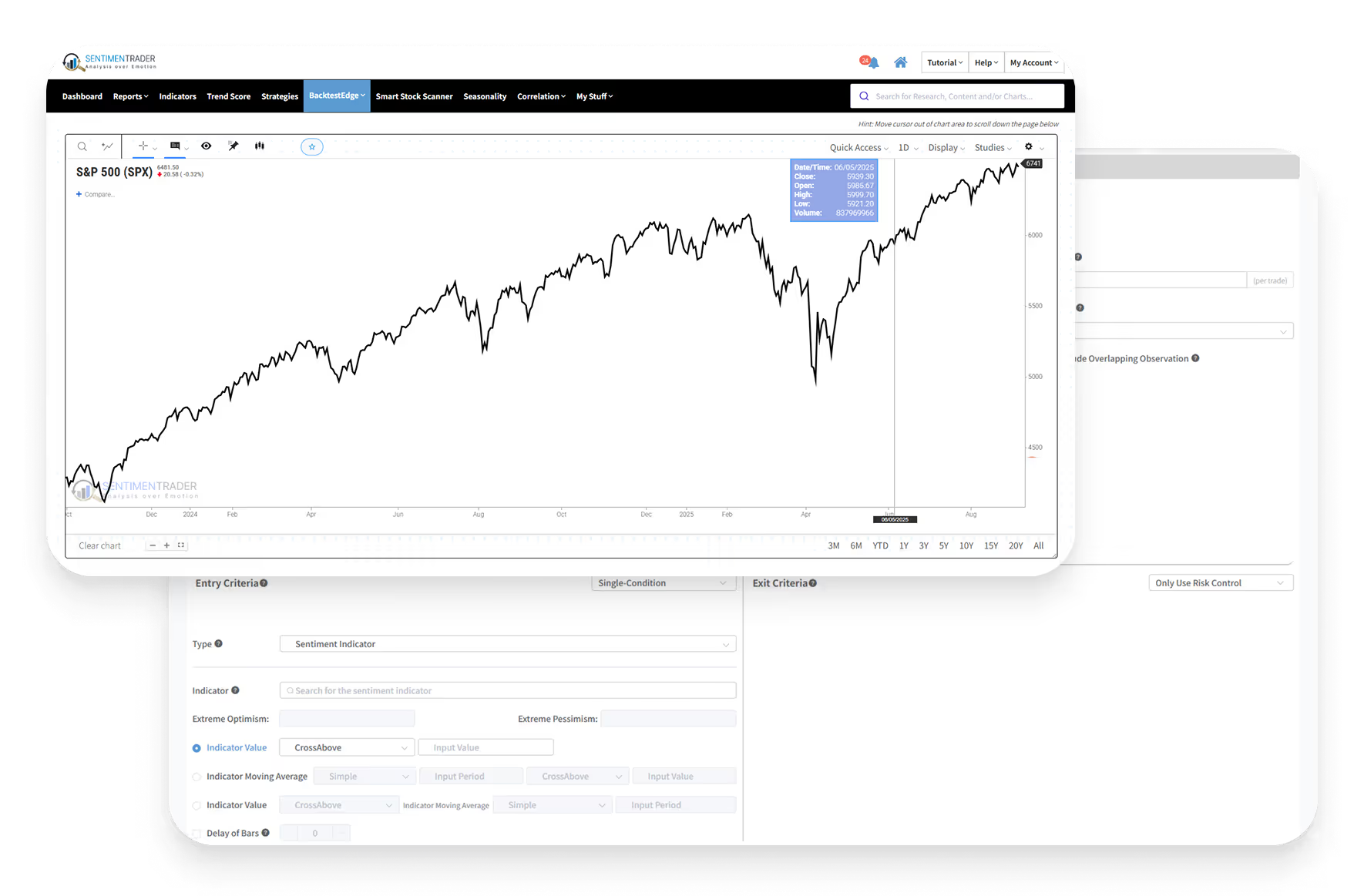
This is a proprietary SentimenTrader sentiment indicator, updated daily and available exclusively to subscribers. It can also be tested through the SentimenTrader’s Proprietary Backtest Engine to quantify how institutional sentiment extremes have historically influenced market outcomes.